Jiuquan Attraction
Jiayuguan Fort: The Great Wall Western End
The complete guide: history, tickets, the Overhanging Great Wall, best viewpoints, and how to visit China's most dramatic fortress.
Location
6km W of Jiayuguan
Combined Ticket
CNY 120
Built
1372 (Ming Dynasty)
Visit Duration
3-5 hours
Best Time
8:00-10:00 AM
What Is Jiayuguan Fort?
Jiayuguan Fort is the westernmost fortress of the Ming Dynasty Great Wall, built in 1372 at a strategic choke point between the snow-capped Qilian Mountains to the south and the barren Gobi Desert to the north. Known as the "First and Greatest Pass Under Heaven" (天下第一雄关), the fort controlled the narrow Hexi Corridor — the only passage between China and Central Asia — for over five centuries.
Unlike the more famous Badaling section near Beijing, Jiayuguan is an intact fortress complex, not just a wall section. It includes an inner city, outer city, moat, gate towers, and military barracks — a complete Ming Dynasty border defense system. Walking through the gates, you are tracing the exact steps of Silk Road traders, exiled officials, and Ming Dynasty soldiers who passed through this checkpoint on their way into or out of the Chinese empire.
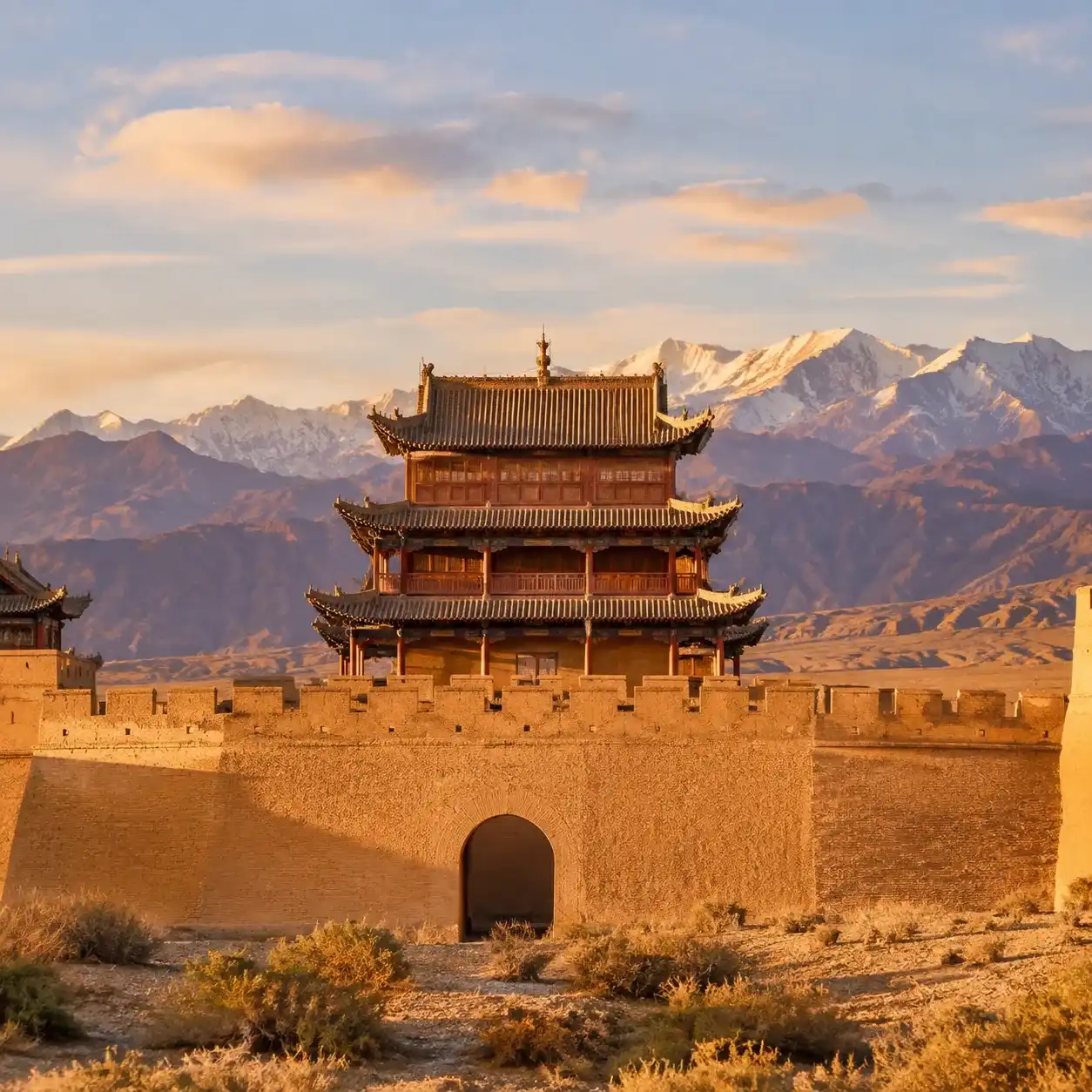
The fort faces west — deliberately. Every brick was laid to face the frontier. On a clear day, you can see the Qilian Mountains' snow-capped peaks rising behind the fort's three-story gate tower, creating one of the most dramatic fortress backdrops in the world.
The Combined Ticket: What You Get for CNY 120
Jiayuguan Fort
The main fortress. Inner city walls are 11 meters high. Three gate towers. Walk the full perimeter wall for views of the Gobi Desert on one side and the Qilian Mountains on the other. The west gate tower is the iconic photo spot. Allow 1.5-2 hours.
Great Wall Museum
Located inside the fort complex. Covers the full history of the Great Wall from the Warring States period through the Ming Dynasty. Surprisingly well-curated with English signage. Good for context before or after walking the fort. Allow 30-45 minutes.
Overhanging Great Wall (悬壁长城)
A dramatic section of the Great Wall that climbs steeply up the Qilian Mountains, 8 km north of the fort. The wall appears to hang off the mountainside. A challenging 30-minute uphill climb with incredible panoramic views. Included in the combined ticket. Separate location — you need transport between sites. Allow 1-1.5 hours including the climb.
Important: All three sites on one ticket, one day.
The combined ticket is valid for one calendar day across all three sites. Start at the fort in the morning, visit the museum, then drive to the Overhanging Great Wall. Buying separately would cost CNY 180+, so the combined ticket saves you CNY 60 per person.
Fort Architecture & Best Viewpoints
The West Gate Tower
The three-story gate tower facing the Gobi Desert is the single best photo spot. Shoot from the inner courtyard looking up for dramatic vertical compositions. Or walk outside the west gate and shoot back toward the tower with the Qilian Mountains behind. Morning light (8:00-10:00 AM) illuminates the tower face directly.
The Perimeter Wall Walk
Climb onto the fortress walls and walk the full perimeter. The contrast between the fort's geometric precision (perfect right angles, symmetrical towers) and the untamed desert beyond is striking. On clear days, the snow line of the Qilian Mountains forms a white band across the southern horizon.
The Overhanging Wall Ridge
After the steep 30-minute climb, the view from the top is one of the best panoramic vistas on the Silk Road. The wall snakes along the ridge, the Gobi spreads to the north, and the Qilian Mountains fill the southern horizon. Bring a wide-angle lens. The climb is steep but has handrails and rest platforms. Not suitable for those with mobility issues or fear of heights.
A Short History
Jiayuguan was built in 1372 under the Hongwu Emperor, founder of the Ming Dynasty, as the western anchor of China's border defenses. The site was chosen with precision: the Qilian Mountains and the Gobi Desert create a natural funnel here, forcing all overland traffic through a passage only 15 kilometers wide.
For the next 500 years, every trader, diplomat, soldier, and exile entering or leaving China along the Silk Road had to pass through Jiayuguan's gates. The fort became synonymous with the edge of the Chinese world — to be sent "beyond Jiayuguan" was a sentence of exile into the unknown west. A legend says the fort's architect calculated the exact number of bricks needed so precisely that only one brick remained unused — it sits on a gate tower to this day.
In the 20th century, the fort's significance shifted from military to industrial when the Jiuquan Iron and Steel Company built a massive steel plant nearby, transforming Jiayuguan from a remote garrison town into a modern industrial city. Today it is one of China's most visited historical sites, though still far less crowded than the Badaling Great Wall near Beijing.
Practical Tips
- Go in the morning (8:00-10:00 AM). The fort faces west — morning light illuminates the gate tower face directly. Afternoon creates harsh backlight. Also cooler for walking the walls.
- Budget 3-5 hours for all three sites. Fort (1.5-2h) + Museum (30 min) + Overhanging Wall (1-1.5h including drive). The Overhanging Wall is 8 km from the fort — taxi (CNY 30-40) or Didi works.
- Stay in Jiayuguan, not Jiuquan. Jiayuguan is 20 km closer to the fort, has better hotels, more restaurants, and better tourist infrastructure. Jiuquan city center adds an unnecessary 40-minute round trip. See our accommodation guide.
- Wear sturdy shoes for the Overhanging Wall. The climb involves steep, uneven steps. Sandals or flip-flops are dangerous. The wind at the top can be strong — secure hats and loose items.
- Bring your passport. Tickets are linked to passport numbers. No passport = no entry. This is strictly enforced at all three sites.
- Combine with Dunhuang by high-speed train. Jiayuguan/Jiuquan is a 2.5-hour train from Dunhuang. Many travelers do 3 days in Dunhuang then take the morning train, arriving in Jiayuguan with a full afternoon for the fort. See transport options.
Walk the Great Wall's western end
Our itinerary planner includes Jiayuguan Fort with exact timing and transport between sites.
Sources & References
- → UNESCO World Heritage: The Great Wall — includes Jiayuguan Pass
- → Jiayuguan Pass on Wikipedia — historical background and architecture
- → Ticket prices verified at Jiayuguan Fort ticket office, July 2026